There are many configurations that can be given to a kitchen: linear, angular or with a central island, but without a doubt the island kitchen is very popular at the moment. Certainly show-cooking and TV cookery programmes have also helped the rise of this kitchen model.
Island kitchens have countless advantages, both in terms of aesthetics and functionality. Let’s take a look at them and consider some aspects to best design this type of kitchen, certainly considering the measurements, but also the organisation of the space on the island itself
The advantages of kitchens with an island
First and foremost, and the one that usually makes people opt for this choice, is the possibility of combining kitchen and living area in a single room that dialogues. This is the ideal solution for open-plan flats, where a single space serves several functions.
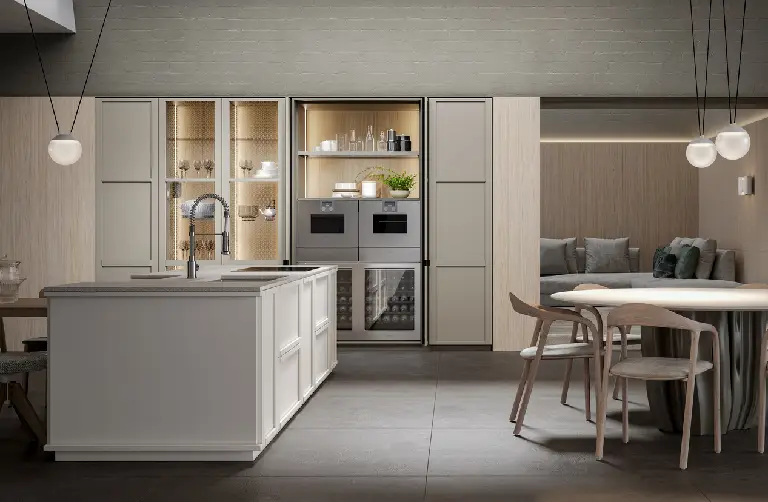
In recent years, the trend has been to incorporate the kitchen into a larger room and not to constrain and confine it to a separate room. After all, the kitchen is the centre of the home, the room most used, where family relationships are cultivated. It is therefore right that the right space and importance be given to this room.
The conformation of island kitchens allows natural communication with the living area, which is useful both to keep an eye on children playing and to be part of the evening even while cooking.
Island kitchens are a real solution for those who love cooking together. Obviously, in these cases the island must be operational, i.e. present the hob and, if necessary, the sink.
Another practical advantage is utilising the space under the worktop with capacious drawers, baskets or even doors. The kitchen space increases, but at the same time being central is extremely functional.
Finally, another advantage, purely aesthetic, can be to conceal appliances from the living area, to create extremely clean and uncluttered spaces.
The measurements needed to evaluate a kitchen with an island
It is often thought that a kitchen with an island requires a large house. In reality, this is not the case, because a kitchen with an island can easily be fitted even in a small house, as long as the space is well calculated.
In some cases, a compromise solution may otherwise be a kitchen with a peninsula, because in this case the space requirement is reduced.
Let us therefore look at the dimensions of the island and the main measurements to consider.
First of all, the overall dimensions of the island or peninsula must be calculated. This depends on the base units and appliances you decide to fit, plus the space that must be left to allow passage and work in the room.
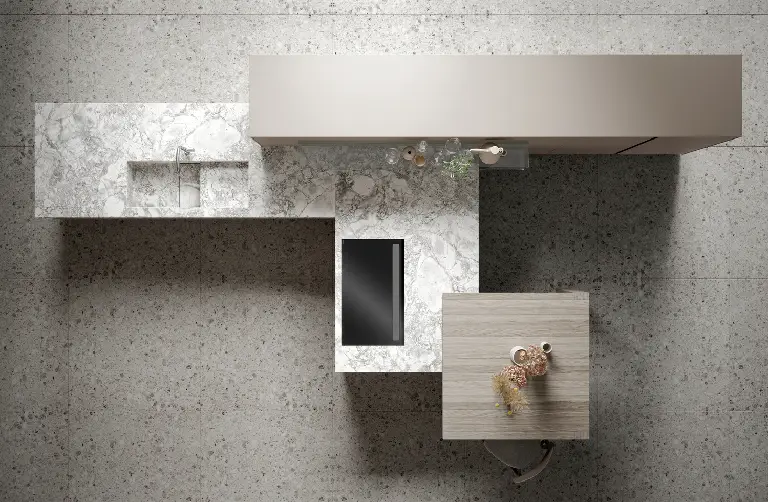
As far as width is concerned, a kitchen island can be at least 90 cm wide if it is only used as a base unit. If, on the other hand, the hob or sink is to be placed, the island must be at least 200 cm wide.
The space to be left at the sides, between the kitchen island and the walls, is at least 90 cm per side to facilitate passage. On the other hand, the space to be left between the island and the other kitchen wall is larger to allow doors and drawers to be opened on both sides at the same time. In this case it is preferable to leave a minimum of 100 cm up to 120 cm if space permits.
As far as depth is concerned, it ranges from a minimum of 60 cm up to 100 cm, space permitting. Naturally, the greater the depth, the more functional the island will be. Deeper islands are usually made up of paired storage units that therefore have doors and drawers on both sides. So if the kitchen is small, the island or peninsula can increase the storage space a lot, but without making the composition heavier.
It should be considered that base units facing the living area can also become storage. In this case the island becomes a perfect functional border piece of furniture
The height of the island should be chosen according to its function. In fact, if it is only used for cooking, its height is between 85 and 90 cm, but this height can be increased to a maximum of 105 cm.
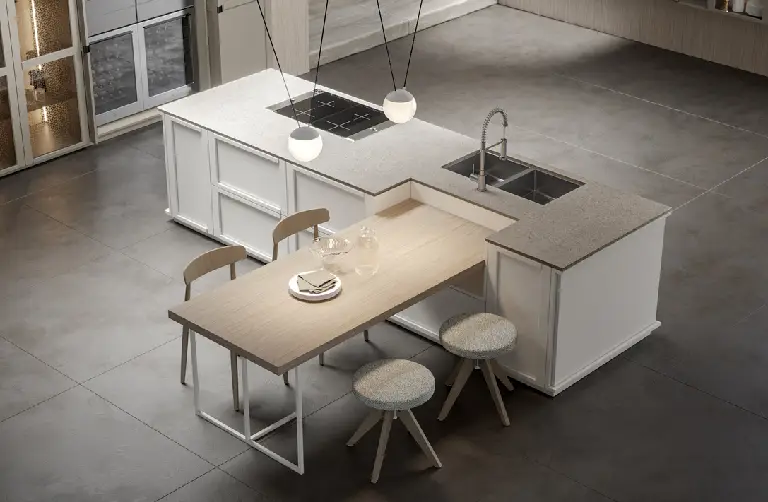
A current trend is to keep the island at a height of 90 cm and attach a lower top to it that can be used as a real dining table.
Discover our solutions and come to the Point of Sale to create your own kitchen to make the most of your home.